

Restorative Correction Framework (RCF)
A District-Scale System for Aligning Educator Responses to Student Behavior
The Restorative Correction Framework (RCF) is a structured, multi-tiered system that equips educators to identify the underlying function of student behavior and respond in ways that promote regulation, connection, and sustained engagement in learning. RCF transforms everyday classroom interactions into preventative mental health supports by creating consistency across staff, aligning responses to student needs, and reducing escalation before it requires intensive intervention. Designed for district-scale implementation, RCF integrates into existing MTSS and behavioral health systems and is reinforced through training, coaching, tools, and data.
.png)
Adapted from restorative vs traditional discipline models used in education. https://www.iirp.edu/news/restorative-practices-vs-traditional-discipline
The Challenge
The Challenge In many schools, student behavior is addressed inconsistently:
-
The same behavior receives different responses across classrooms
-
Escalation occurs before underlying needs are identified
-
Educators lack a shared framework for interpreting behavior
-
Mental health supports are disconnected from daily classroom practice
As a result, students experience unpredictability, reduced sense of safety, and increased disciplinary consequences particularly those experiencing stress, trauma, or unmet needs.
The Solution
RCF provides a shared behavioral insight framework that enables all school personnel to:
• Identify the function of student behavior in real time
• Apply aligned, trauma-informed responses
• Reduce escalation and increase regulation
• Create predictable, consistent classroom environments.
This approach strengthens Tier 1 and Tier 2 supports and improves coordination with mental health providers.
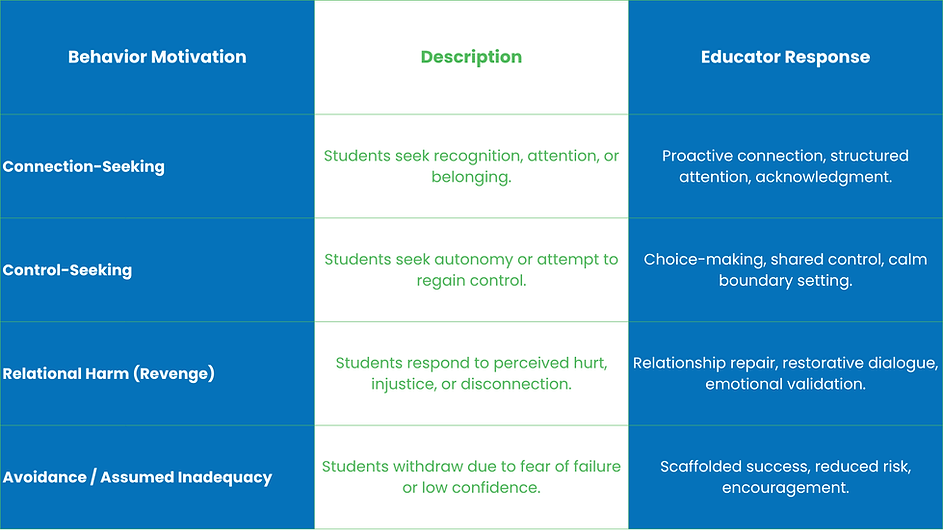
The Four Behavior Functions
At the core of RCF is a simple, powerful model that helps educators understand behavior as communication:
.png)

RCF Impact Metrics
Evidence-Aligned Outcomes of Implementation

These outcomes are based on research from established frameworks including PBIS (Positive Behavioral Interventions and Supports), MTSS (Multi-Tiered Systems of Support), restorative practices, and trauma-informed education models. Results may vary depending on implementation fidelity and system context.
RCF is designed as a scalable district-level framework supporting consistent, trauma-informed behavioral responses across classrooms and teams. Downloadable Evidence-Aligned Resources
Integration with School-Based Mental Health Systems
RCF strengthens existing behavioral health infrastructure by:
-
Expanding Tier 1 and Tier 2 supports through educator practice
-
Improving early identification of student needs
-
Aligning classroom responses with mental health provider interventions
-
Creating shared language across educators, families, and partners
This ensures that behavioral health support is embedded within the daily school experience—not limited to specialized services.


Partnership Model
All-Star Academy partners with districts, state agencies, and community organizations to implement RCF as part of a comprehensive approach to student wellness.
Our role includes:
-
Professional learning design and delivery
-
Implementation tools and resources
-
Coaching and fidelity support
-
Data alignment and continuous improvement
-
Collaboration with behavioral health providers and education agencies
RCF is frequently implemented as part of larger initiatives, including federal and state-funded programs focused on school-based mental health.
Designed for Sustainability
RCF is built to last beyond initial implementation through:
-
Development of internal staff leaders
-
Integration into existing district systems
-
Reusable tools and training resources
-
Ongoing coaching structures that can be sustained internally
Let’s Connect
If your district is working to strengthen behavioral health supports, improve consistency in student responses, or reduce disciplinary disparities, we welcome the opportunity to collaborate. Contact All-Star Academy to learn more about implementing the Restorative Correction Framework.